Sujata vs Philips Mixer Grinder: The Ugly Truth (2026)
Choosing between a Sujata vs Philips mixer grinder is the toughest decision for an Indian kitchen.
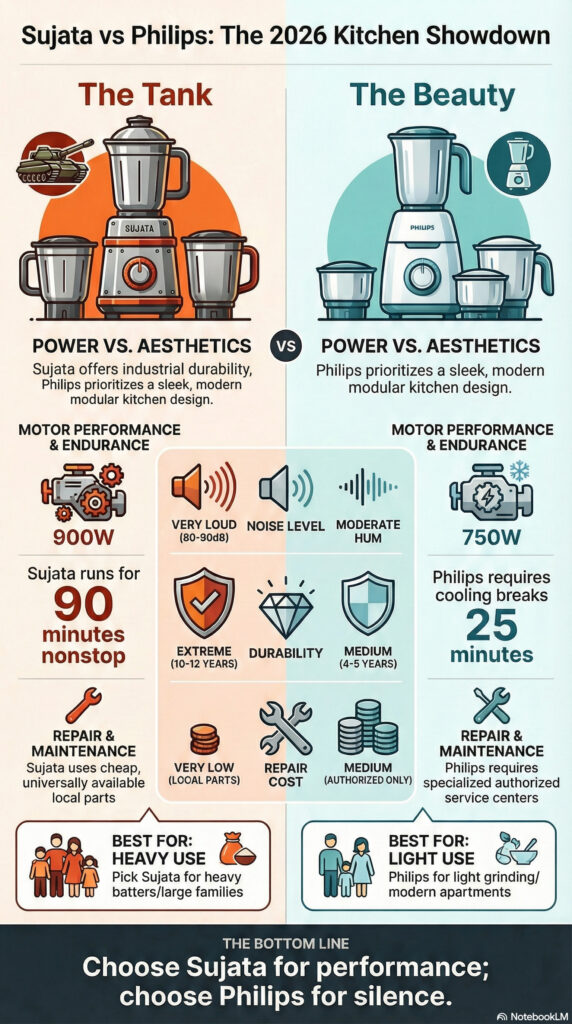
On one side, you have the Sujata Dynamix (900W). People call it the “Tank.” It is ugly, loud, and looks like it belongs in a canteen, but it grinds tough turmeric in seconds and never dies.
On the other side, you have the Philips HL7756 (750W). It is the “Beauty.” It is sleek, compact, and fits perfectly in a modern modular kitchen without waking up the neighbors.
But which one is actually worth your money in 2026?
Does the Sujata really sound like a jet engine? Does the Philips really struggle with Idli batter? I am skipping the boring technical manual to give you the unfiltered truth.
Let’s find out which machine survives the real “Indian Kitchen Test.”
Also read our post on: Sujata vs Bosch Mixer Grinder (2026):Noise & Durability Test
Review at a Glance: Sujata vs Philips Mixer Grinder
If you don’t have time to read the full breakdown, here is the quick verdict based on our “Turmeric & Noise” tests.
| Feature | Sujata Dynamix (The Tank) | Philips HL7756 (The Beauty) | The Winner |
|---|---|---|---|
| Best For | Large families, Idli/Dosa batter, tough masalas. | Bachelors, small families, daily chutneys. | Depends on Use |
| Motor Power | 900 Watts (Double Ball Bearing). Non-stop running for 90 mins. | 750 Watts. Good for 25 mins (needs cooling breaks). | Sujata (By far) |
| Noise Level | Very Loud (80-90 dB). Sounds like a construction site. | Moderate. It has a hum, but it’s not scary. | Philips |
| Durability | Extreme. Can easily last 10-12 years. | Medium. Expect 4-5 years of good service. | Sujata |
| Repair Cost | Very Low. Uses standard parts found at any local shop. | Medium. Requires authorized service center. | Sujata |
| Aesthetics | Bulky, retro, and “industrial” look. | Slim, premium finish, looks great on counters. | Philips |
| Buy Now | Check Price on Amazon | Check Price on Amazon |
The Bottom Line
- Buy the Sujata Dynamix if you want a machine that never dies and you don’t care about the noise. It is the best choice for heavy Indian cooking (Batters & Spices).
- Buy the Philips HL7756 if you have a modern open kitchen, live in an apartment with thin walls, or mostly just make chutneys and smoothies.
1. Grinding Power: Can It Handle “Pathar” Hing?
When you compare the Sujata vs Philips mixer grinder, the biggest difference is not the look. It is the raw muscle inside the machine.
You don’t just need “Watts.” You need a motor that doesn’t get tired. Here is how they perform in a real Indian kitchen.
The Sujata Advantage: The “Double Ball Bearing”
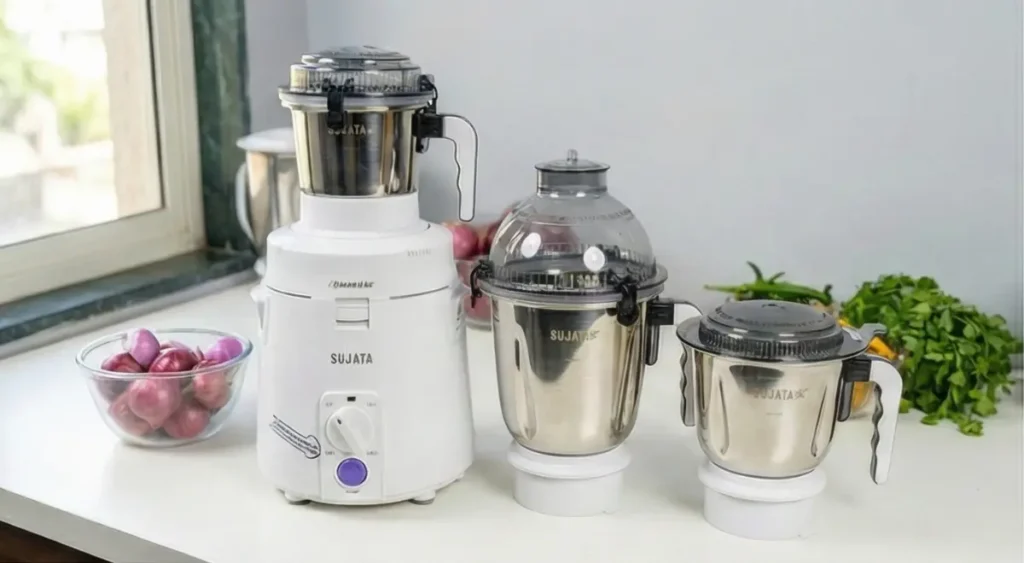
The Sujata Dynamix has a 900-watt motor with Double Ball Bearings.
- What is it? Most mixers use cheap plastic bushes. Sujata uses steel bearings (like the wheels on a skateboard).
- The Benefit: It reduces friction. The motor does not get hot even if you run it for a long time.
- Real World Result: You can run the Sujata for 90 minutes nonstop. If you have a large family and need to grind two huge batches of Idli batter back-to-back, Sujata won’t even sweat. It powers through dried turmeric (haldi) and rock hing without stopping.
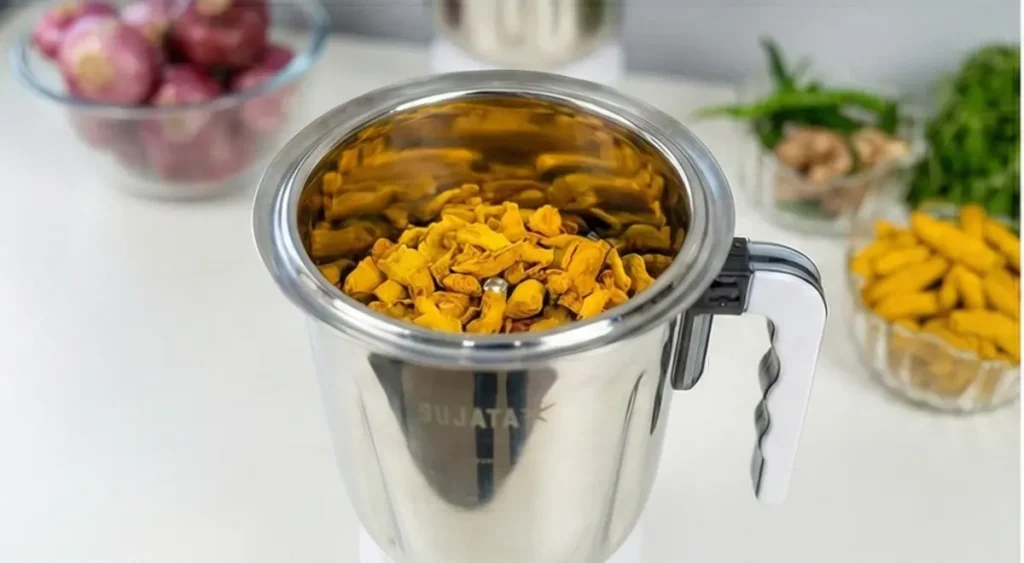 Sujata Mixer Grindre Turmeric Test
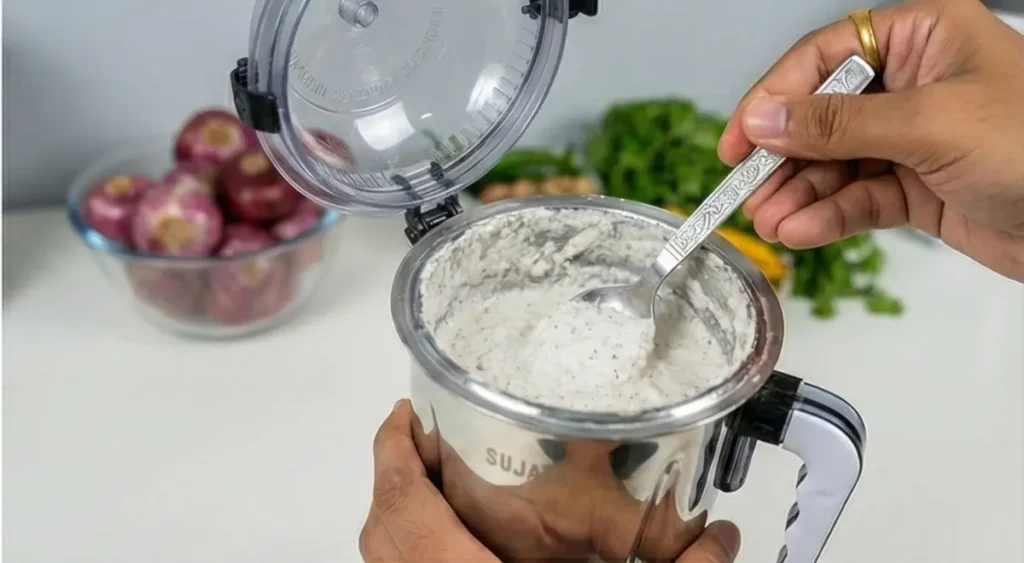 Sujata Mixer Grindre wet grinding Test
The Philips Reality: Good for Daily Use
The Philips HL7756 comes with a 750-watt Turbo Motor.
- The Performance: It is perfect for ginger-garlic paste, coriander chutney, and tomato puree. It is fast and efficient for daily cooking.
- The Limit: It struggles with heavy loads. If you try to grind 1kg of soaked rice or very hard spices at once, the motor might heat up. The Overload Protector (OLP) will trip to save the machine, and you will have to wait for it to cool down.
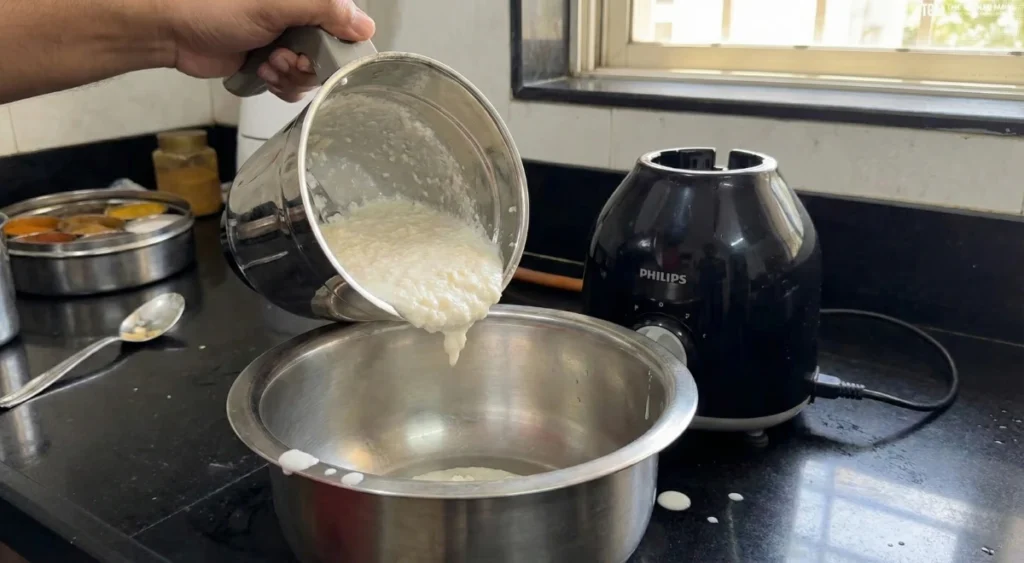 Philips Wet Grinding test
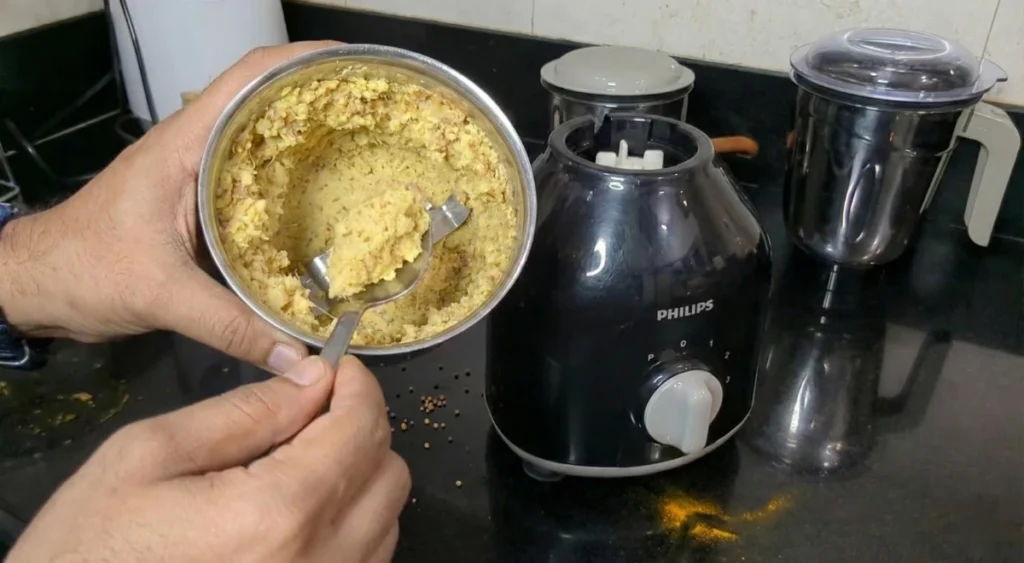 Philips Grinding test
Performance Breakdown: The “Kitchen Test”
I tested both machines on three common tasks. Here is what happened.
| Task | Sujata Dynamix | Philips HL7756 |
|---|---|---|
| Dried Turmeric (Haldi) | Powdered it in seconds. No struggle. | Struggled. The jar shook violently. |
| Idli/Dosa Batter | Smooth paste. Motor stayed cool. | Good paste, but needed 2-3 breaks to cool down. |
| Chutneys & Purees | Very fast (sometimes too fast). | Perfect consistency. |
The Verdict: If you cook heavy meals or grind your own masalas, the Sujata is the clear winner. If you only do light grinding for a small family, the Philips is more than enough.
2. Noise Levels: Will It Wake the Neighbors?
If you check any forum discussing Sujata vs Philips mixer grinders, 90% of the complaints are about noise. Let’s be honest about what to expect.
The “Sujata Sound”
Sujata trades silence for raw speed.
- The Reality: It is loud. Very loud. It sounds a bit like a drill machine or a jet engine taking off.
- Why? The motor spins at a massive 22,000 RPM. The high airflow keeps the motor cool, but it creates a lot of wind noise.
- The Trade-off: If you live in a small apartment with thin walls, your neighbors might know when you are making chutney at 7 AM.
Pro Tip to Fix the Noise: If you buy the Sujata, place a thick rubber mat or a folded towel underneath it. This absorbs about 20% of the noise and stops the machine from “walking” or vibrating on your kitchen counter. It is a ₹50 hack that makes a huge difference.
The Philips Experience
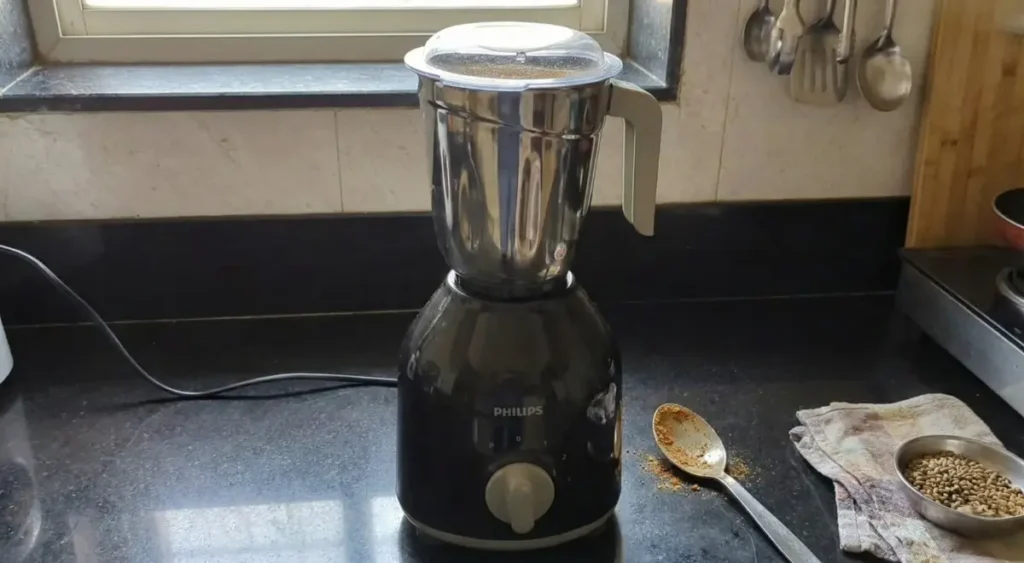
Philips is not “silent” (no mixer is), but it is much more civilized.
- The Reality: It makes a standard mixer hum. It is bearable and won’t scare a sleeping baby in the next room.
- Why? The body is fully enclosed, which muffles the motor vibration better than Sujata’s open-style frame.
The Verdict: If you are sensitive to noise, pick the Philips. If you can tolerate 2 minutes of noise for better grinding, stick with Sujata.
3. Juicing & Shakes: Smooth vs. Pulpy?
Most people focus on the chutney jar, but what if you want fresh fruit juice or a chocolate shake? There is a big difference in how these two brands handle liquids.
Sujata: The “Whole Fruit” Approach
The Sujata Dynamix is a grinder first, blender second.
- The Benefit (Pulp Power): It does not typically come with a mesh filter jar. It blends everything—skin, pulp, and fiber—into a thick consistency.
- Result: You get a “pulpy” texture. If you want clear juice, you will have to pour it through a manual strainer after blending.
- Note: If you want professional juicing, you have to buy the Sujata Powermatic model, which has a massive separate juicer attachment (like a juice shop machine), but the standard Dynamix does not have this.
Philips: The “Smoothie” Specialist
Many Philips models (and compatible jars) come with a focus on blending.
- The Benefit (Mesh Filter): Philips is famous for its blender jars that often support a fruit filter (a mesh tube inside the jar). This separates the seeds and pulp from the juice.
- Result: You get smooth, clear watermelon or orange juice without needing a strainer. Ideally suited for modern smoothies.
The Verdict: For heavy shakes where you don’t mind the pulp, Sujata works fine. For clear juices and smoothies, Philips is more convenient.
4. Design & Build Quality: The “Coupler” Issue
The Coupler is the small plastic wheel that connects the jar to the mixer motor. This is the part that breaks most often in any mixer.
Sujata’s “Cheap” Strategy
Sujata uses white plastic couplers on both the jar and the motor.
- The “Problem”: These plastic teeth can wear out if you are rough with the jars.
- The Hidden Benefit: They are designed to break! If a stone or spoon accidentally falls into the jar, the cheap plastic coupler breaks to save the expensive motor.
- Easy Fix: You don’t need a service center. You can buy a spare coupler for ₹20 at any local electrical shop and change it yourself.
Philips’ “Premium” Strategy
Philips uses tougher nylon/rubber couplers.
- The Benefit: They are durable and don’t wear out easily. They feel higher quality.
- The Problem: If they do break (which is rare), finding the specific spare part can be harder. You usually have to visit an authorized center.
Jar Quality
- Sujata: The jars are pure functional steel. They are wide and easy to clean, but the lids can be tight.
- Philips: The jars look better and often come with locking clips (hands-free operation), so you don’t have to hold the lid down while grinding.
The Verdict: Philips wins on convenience (hands-free lids). Sujata wins on long-term repairability (cheap, easy-to-find parts).
5. The “Burning Smell” Anxiety: Don’t Panic!
This is the number one question we see from new buyers of both brands.
- The Scenario: You unbox your shiny new mixer, plug it in, run it for the first time, and suddenly—there is a strong smell of burning varnish or plastic.
- The Reaction: You panic. You think, “Oh no, I bought a defective piece!”
The Truth
Relax. This is completely normal.
Whether you buy the Sujata Dynamix or the Philips HL7756, the motor windings are coated with a protective varnish. When the motor heats up for the first few times, this varnish burns off slightly.
- Does it last? No. The smell usually disappears after the first 3-4 uses.
- Warning Sign: If the smell continues after 10 uses, or if you see smoke, then you have a problem. But for the first week, ignore it.
Note: Philips users tend to report this smell lingering a bit longer than Sujata users, but it is not a defect.
6. After-Sales Service: Local vs. Center?
This is the “hidden cost” nobody talks about until their mixer breaks.
Sujata: The “Maruti” of Mixers
Sujata is an Indian brand that has been around for decades.
- The Benefit: It is incredibly simple to fix. You do not need to hunt for a “Sujata Authorized Center.”
- The Reality: Almost any local electrical repair shop in your market will have Sujata spare parts. The parts are standard, cheap, and available everywhere. It is a “mechanic-friendly” machine.
Philips: The “Corporate” Experience
Philips is a global giant with a structured service network.
- The Benefit: They have professional service centers in all major cities. The service is professional and organized.
- The Reality: If you live in a Tier-2 or Tier-3 city, finding parts can be a headache. You cannot just go to the local repair guy; he might not have the specific Philips coupler or jar socket. You are dependent on the authorized center.
The Verdict: If you want hassle-free, cheap repairs anywhere in India, Sujata wins.
Final Verdict: Which One Should You Buy?
We have compared the motors, the noise, the couplers, and the grinding speed. Now, it is time to choose.
The honest truth is that there is no “perfect” mixer. You have to choose what annoys you less: the loud noise of the Sujata or the lower power of the Philips.
Buy the Sujata Dynamix (900W) if:
- You are a heavy user: You make Idli/Dosa batter or grind hard turmeric regularly.
- You want durability: You want a machine that you can pass down to the next generation (or at least use for 10+ years).
- You value cheap repairs: You want the peace of mind that any local mechanic can fix it for ₹50.
- You don’t care about looks: You are okay with a bulky, “industrial” looking machine on your counter.
Buy the Philips HL7756 (750W) if:
- You value peace and quiet: You live in an apartment and hate loud noise.
- You have a modern kitchen: You want a sleek, stylish appliance that looks good.
- You are a moderate user: You mostly grind chutneys, ginger-garlic paste, and occasional batters.
- You want convenience: You love the “hands-free” locking clips and the fruit filter for clear juice.
My Personal Recommendation
If I had to spend my own money for an Indian kitchen, I would buy the [Sujata Dynamix].
Why? Because 5 years from now, you won’t remember the noise, but you will remember the frustration if your mixer stops working in the middle of grinding batter. Sujata is ugly, loud, and brute—but it gets the job done every single time.
Also learn about, saving upto 2000 rs, in our blogpost: Sujata vs Bajaj mixer grinder: Is Sujata Worth Extra ₹2000?
FAQs on: Philips vs Sujata Mixer Grinder
Here are quick answers to the most common doubts about the Sujata vs Philips mixer grinder.
Q: Is the Sujata mixer grinder too noisy for apartments?
Yes, it is very loud (80-90 dB). If you live in an apartment with thin walls, your neighbors will definitely hear it. However, it only takes 2 minutes to grind batter, so most users find it manageable. If silence is your priority, pick the Philips HL7756.
Q: Can Sujata Dynamix grind 1kg idli batter?
Yes, easily. The 900-watt Double Ball Bearing motor is designed for commercial-level loads. You can grind 1kg of soaked rice in a single batch without the motor heating up or stopping.
Q: Which one is better for making small amounts of chutney?
The Philips HL7756 wins here. Its chutney jar is designed for small quantities (like a quick coriander dip). The Sujata jars are wider at the bottom, so sometimes the blade spins above the chutney if you are grinding a very small amount.
Q: What is the difference between Sujata Dynamix and Powermatic?
They have the exact same motor (900W). The only difference is the jar size.
Dynamix: Comes with 3 smaller jars (better for daily home use).
Powermatic: Comes with a huge “Juicer” attachment (better if you drink fresh juice daily).
Verdict: For most Indian kitchens, Dynamix is the better buy.
Q: Can the Sujata Dynamix run on a home inverter?
Yes, but be careful. It draws a massive 900 Watts. If you have a standard 850VA inverter (common in Indian homes), it might trip if you run fans or lights at the same time. The Philips (750W) is much easier on home inverters.
Q: Does the Philips HL7756 have a copper motor?
Yes, the Philips HL7756 uses a copper-wound motor. However, Sujata’s copper motor is generally considered more durable because of the heavy-duty bearings that reduce heat.
That is the Overload Protector (OLP). Philips is sensitive to overloading. If you fill the jar to the top with heavy batter, it will trip to save the motor. Reduce the load to half the jar, and it will run smoothly. Sujata rarely trips because the motor is more powerful.
