Kent RO vs Aquaguard: Which Water Purifier is Best for Indian Homes?
The battle of the water purifiers is legendary in India. You ask one neighbor, and they swear by Kent RO. You ask another, and they claim Aquaguard is the only brand they trust.
If you are reading this, you are likely standing on the fence, worried about making a wrong choice. Will the water taste bitter? Will the service guy actually show up? Is the machine going to cost a fortune to maintain?
Our Kent RO vs Aquaguard guide cuts through the marketing noise. We don’t just compare specifications; we compare your experience as an owner.
Also learn about our comparison on: Aquaguard and Pureit Water Purifiers
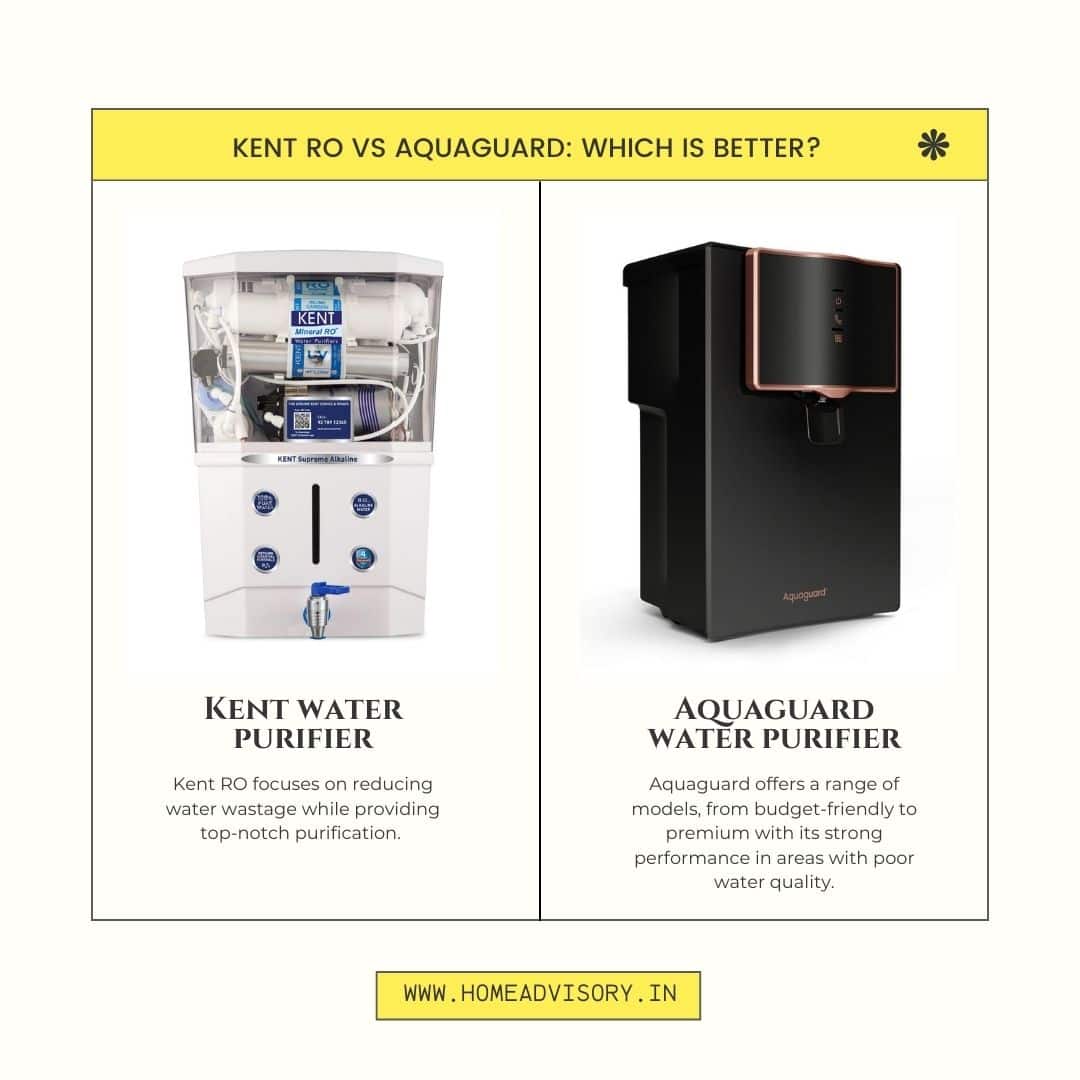
Kent RO vs Aquaguard at a Glance: 30-Second Verdict
If you are in a rush, here is the quick answer based on real Indian household conditions.
| Choose Kent RO If… | Choose Aquaguard If… |
|---|---|
| You use Borewell Water (High TDS > 500). | You use Corporation/Municipal Water (Low TDS < 500). |
| You want “Medical Grade” pure water and don’t mind a neutral taste. | You are very particular about “Sweet” tasting water (similar to clay pot water). |
| You live in a Metro City (Delhi, Mumbai, BLR) where their service is fastest. | You live in a Tier-2 or Tier-3 City where their massive service network reaches better. |
| You want to reuse rejected water (Zero Water Wastage technology). | You want a sleek, modern machine that looks good in a modular kitchen. |
Kent vs Aquaguard: Water Taste Comparison
This is the #1 complaint new buyers have: “The water tastes bitter!”
Aquaguard: The Taste Master
Aquaguard understands the Indian palate. We are used to drinking water from earthen pots (matka) or boiled water, which has a specific “sweetness.”
- Active Copper & Zinc: Aquaguard adds a cartridge that infuses Copper and Zinc ions. This not only boosts health but gives the water that familiar, refreshing sweet taste.
- Mineral Guard: This technology ensures that natural minerals like Calcium and Magnesium are not stripped away during purification.
Kent RO: The Control Freak
Kent focuses on “purity” above all else. Their water tastes very neutral—almost like bottled mineral water.
- TDS Controller: This is Kent’s secret weapon. If you find the water too bitter (which happens when water is too pure), the technician can physically turn a knob inside the machine to retain more natural minerals. This gives you control over the taste.
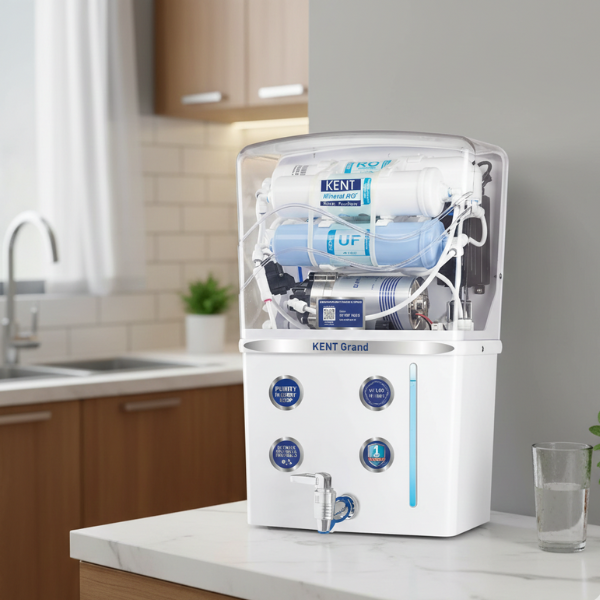
Bottom Line: If you are a “water foodie,” go for Aquaguard. If you want absolute control over purity, go for Kent.
Kent RO vs Aquaguard: Does the RO Technology Actually Differ?
Both Kent and Aquaguard use Reverse Osmosis, but they are not the same RO.
Kent uses what they call “Mineral RO Technology.” The water passes through the RO membrane first, which strips almost everything out.
Then it goes through a TDS controller that mixes back some of the original tap water. You end up with purified water that still has some natural minerals. The key difference is that you can physically adjust how much mineral-rich water gets mixed back in.
Aquaguard takes a different path. Their RO membranes are paired with “Mineral Guard” and “Active Copper” cartridges that add minerals after purification rather than retaining original ones. The result is more consistent — every glass tastes the same regardless of your input water quality.
Here is what this means in practice. If your input water TDS keeps changing (common if you get a mix of tanker and borewell water), Kent gives you more control because you can keep adjusting the TDS knob.
If your water source is stable (like corporation supply), Aquaguard’s automatic mineral addition works better because there is nothing to fiddle with.
One more thing most comparison articles miss: Kent’s RO membranes use standard industry sizing. After warranty, you can buy compatible membranes for ₹1,200 instead of the official ₹2,500 one.
Aquaguard membranes are proprietary — you must buy from them at ₹2,800-₹3,500. This single difference saves Kent users ₹1,500+ per year after the warranty period ends.
Which is Better for Hard Water? (Borewell vs Municipal)
Not all machines can handle the “Khara Paani” (Hard Water) supplied in many Indian colonies.
For High TDS (Borewell Water)
Winner: Kent RO Kent machines are built like tanks. Their high-pressure pumps and industrial-grade RO Membranes are legendary for handling TDS levels of 2000+ ppm without choking. If you rely on groundwater that leaves white scaling on your buckets, you need a Kent Grand+.
For Low TDS (Corporation Water)
Winner: Aquaguard If you get municipal water (TDS < 500), using a heavy RO machine is overkill and actually unhealthy (it removes too many minerals). Aquaguard offers specialized “Dr. Aquaguard” models with UV+UF technology. These purify water without removing the natural minerals, perfect for soft water zones.
Best Water Purifier by City and Water Type
Stop reading generic advice. Here is what actually works based on the water conditions in major Indian cities.
| City | Typical Water Source | Usual TDS Range | Best Pick | Why |
|---|---|---|---|---|
| Delhi NCR | Borewell + Tanker | 500–1500 ppm | Kent Grand+ | High TDS needs heavy-duty RO. Kent handles the fluctuating tanker-borewell mix better. |
| Mumbai | BMC Municipal | 80–200 ppm | Aquaguard UV+UF model | Low TDS. RO is overkill and wastes minerals. UV+UF is enough. |
| Bangalore | Cauvery + Borewell mix | 200–600 ppm | Kent with TDS controller | TDS swings between seasons. You need the adjustable TDS knob. |
| Chennai | Metro Water + Borewell | 400–1200 ppm | Kent Grand+ | Notoriously hard water. Only a strong RO handles it. |
| Hyderabad | HMWSSB + Borewell | 300–800 ppm | Kent or Aquaguard RO | Depends on your specific area. Test TDS first. |
| Kolkata | Municipal | 100–300 ppm | Aquaguard Sure Delight NXT | Soft water. Budget-friendly UV+UF option works perfectly. |
| Pune | PMC Municipal | 150–400 ppm | Aquaguard Delight NXT | Moderate TDS. Aquaguard’s taste enhancement shines here. |
| Jaipur | Borewell heavy | 800–2000 ppm | Kent Grand+ or Kent Supreme Alkaline | Extremely hard water. Kent is the only reliable option. |
| Tier-2/Tier-3 towns | Varies | Test first | Aquaguard (any RO model) | Aquaguard’s service network in smaller towns is far better than Kent’s. |
A quick note: these are general guidelines based on average water conditions. Your colony or apartment complex might get different water. Always test your TDS before buying.
Service & Maintenance Cost: The Real Numbers
Buying the machine is the easy part. Keeping it running is where the wallet hurts. Many first-time buyers are shocked when they have to pay ₹4,000+ just one year after buying a ₹15,000 machine.
Here is the brutally honest breakdown of service reality in 2026.
A. Service Network Reach
- Aquaguard: They are the “Old Guard” of India. Their reach is massive, covering over 15,000 pin codes. If you live in a smaller town, remote area, or Tier-3 city, Aquaguard is often the safer bet because they will have a technician nearby.
- Kent: Their service is excellent in Metros (Delhi, Mumbai, Bangalore) and Tier-1 cities. However, in smaller towns, they often rely on third-party franchises. This can lead to mixed service quality—sometimes great, sometimes unresponsive.
B. The Cost Comparison: AMC vs. On-Demand
You have two choices: pay for an Annual Maintenance Contract (AMC) or pay as you go.
The AMC Route (Peace of Mind)
Most companies push you to buy this. It covers service visits and filter changes.
- Aquaguard AMC: Approx. ₹4,500 – ₹5,900 / year.
- Kent AMC: Approx. ₹4,000 – ₹5,500 / year.
The “On-Demand” Route (Pay as you go)
If you are smart (and a bit handy), you can skip the AMC and pay only when things break. This is where the brands differ massively.
| Feature / Part Cost | Kent RO | Aquaguard | The Reality Check |
| Spare Parts Access | Universal / Standard (Compatible parts available at any hardware shop) | Proprietary (Sensors often lock the machine if you use non-genuine filters) | Kent wins. It is the “Maruti Suzuki” of purifiers—easy to repair anywhere. |
| RO Membrane (Heart of the machine) | ₹2,500 (Official) ₹1,200 (Market Part) | ₹2,800 – ₹3,500 (Must use genuine) | Kent wins. You have cheaper non-brand options if the warranty is over. |
| Filter Kit (Sediment + Carbon) | ₹800 – ₹1,000 | ₹1,500 – ₹2,200 | Kent filters are significantly cheaper to replace. |
| DIY Repairability | Easy. Transparent cover lets you see the fault. | Hard. Requires specialized tools and unlocking codes. | Kent is better for DIY enthusiasts. |
Also read our post on: Aquaguard filter change cost to know more.
C. The “Service Scam” Warning
Be careful of local technicians who use a TDS Meter to scare you.
- The Trick: They measure your purified water and say, “Look! TDS is 80. It should be 20. Your membrane is failed!”
- The Truth: RO water with TDS between 50-150 is healthy. You do not need 20 TDS water (it is acidic and bitter). Do not change your expensive membrane just because the TDS rose slightly. Only change it if the water tastes salty or the flow becomes very slow.
Expert Verdict on Cost:
- Choose Kent if you want to save money in the long run. Since it uses standard parts, any local mechanic can fix it cheaply if you don’t want to pay official rates.
- Choose Aquaguard if you want zero headaches and don’t mind paying a premium for official company service and genuine parts every year.
Water Wastage Comparison: Zero Wastage vs Active Saving
We all feel guilty seeing the RO machine drain water into the sink.
Kent’s “Zero Water Wastage”
Kent is the leader here. Their premium models (like the Grand+) have a secondary pump that pushes the rejected water up to your overhead tank. This means you waste absolutely 0% water. It requires some extra plumbing work during installation, but it is the most eco-friendly option in India.
Aquaguard’s “Active Water Saving”
Aquaguard uses a different approach. They claim to recover 60-70% of the water using advanced membranes. It is better than older machines but not as efficient as Kent’s recirculation system.
Design and Build Quality
- Kent: Practical and Transparent. Most Kent models have a transparent cover. You can see the machinery inside. It looks industrial and reassuring. You can visually check if a filter looks dirty.
- Aquaguard: Sleek and Modern. They invest heavily in looks. Their “Ritz” or “Blaze” series look like premium gadgets that enhance your kitchen’s aesthetics. If you have a modular kitchen, an Aquaguard usually blends in better.
How to Choose the Right Water Purifier: Buyer’s Guide
Buying a water purifier is not like buying a TV. If you buy the wrong TV, the picture might look bad. If you buy the wrong purifier, you risk drinking unsafe water or stripping away healthy minerals.
Follow these 4 simple steps to choose the right machine for your home.
Step 1: The “TDS Test” (Do this First!)
Before you look at any brand, you must know your water’s TDS (Total Dissolved Solids). This is the “Golden Rule” of buying a purifier.
- Order a TDS Meter: It costs less than ₹200 on Amazon.
- Test your tap water: Dip the meter in a glass of tap water.
Ideal Rules
- If TDS is below 300: You DO NOT need an RO. An RO machine will strip the water of all minerals, making it acidic and bitter. Buy a simple UV + UF purifier (Aquaguard has excellent options here).
- If TDS is 300 – 500: You are in the “Grey Zone.” You can use an RO with a TDS controller (Kent models), or a UV purifier.
- If TDS is above 500: You MUST buy an RO purifier. High TDS water contains heavy metals like lead and arsenic that only an RO membrane can remove.
Step 2: Match the Technology to the Water
Don’t get confused by the alphabet soup of acronyms (RO, UV, UF, MF). Here is what you actually need:
- RO (Reverse Osmosis): Removes dissolved salt and heavy metals. Mandatory for Borewell water.
- UV (Ultraviolet): Kills bacteria and viruses. Mandatory for all water types.
- UF (Ultra Filtration): A physical mesh that blocks viruses and cysts. It works without electricity. Good as a backup.
- MTDS / TDS Controller: A valve that adjusts the taste. Essential if you buy an RO. Without this, your water will taste bitter.
Step 3: Family Size vs. Storage Capacity
Imagine waking up in the morning and the purifier is empty. Annoying, right?
- Small Family (1-3 members): A 6-7 Litre tank is sufficient. Most standard models fit this category.
- Large Family (4+ members): Look for a machine with at least 8-10 Litres of storage. Kent Grand+ (9L) is a great choice here.
- Frequent Power Cuts? Ensure you get a model with a large storage tank so you have reserve water when the electricity goes out.
Step 4: Calculate the “Hidden” Annual Cost
The price tag on the box is just the entry fee. Water purifiers require maintenance.
- Filter Changes: You will need to change filters once a year.
- AMC (Annual Maintenance Contract): This covers filter changes and technician visits.
- The Reality Check: Be prepared to spend ₹4,000 to ₹5,500 every year on maintenance. If this is over your budget, look for “Gravity Based” purifiers (non-electric), though they are less effective against high TDS.
Step 5: Do you need Hot Water?
Newer models (especially from Aquaguard) come with a “Hot Water” dispenser.
- Pros: Instant warm water for drinking, tea, or washing fruit. Great for winters.
- Cons: These machines are more expensive and consume more electricity.
- Verdict: Only pay for this if you actually drink warm water daily.
Best Models to Buy in 2026
We have analyzed over 20 models from both brands. Based on service reliability, spare part availability, and consumer feedback in 2025-26, these are the top winners for every need.
1. Kent Grand+ (The Legend): Best Overall for Borewell Water
Best For: Large Families, High TDS Water (Borewell) & Eco-Conscious Buyers.
- Capacity: 9 Litres
- Purification: RO + UV + UF + TDS Control
- Unique Feature: Zero Water Wastage (Recirculation Pump)
Why it wins:
The Kent Grand+ is the “Honda City” of water purifiers. It has been the best-seller for years for one reason: it is a tank. It handles muddy, high-TDS borewell water better than almost any other machine. The 2026 model comes with the “Zero Water Wastage” pump that pushes rejected water back to your overhead tank, solving the biggest ethical problem of ROs.
Pros:
- Universal Repair: Any mechanic in India can fix it; parts are cheap and standard.
- Visible Purity: The transparent cover lets you see if the filters are dirty.
- High Storage: 9 Litres is great for Indian joint families.
Cons:
- Looks Dated: The design is bulky and industrial.
- Installation: Requires extra plumbing work for the “Zero Wastage” pipe.
Product Rating
| Parameters | Notes | How it stacks up |
|---|---|---|
| Performance | Best-in-class for High TDS/Hard Water. | ★★★★★ |
| Water Wastage | Zero Water Wastage Technology. | ★★★★★ |
| Maintenance | Low spare part cost (Universal parts). | ★★★★☆ |
| Design | Bulky, transparent industrial look. | ★★★☆☆ |
2. Aquaguard Ritz (The Premium Choice): Best Design & Taste
Best For: Modular Kitchens, Municipal/Mixed Water & Taste Lovers.
- Capacity: 5.5 Litres
- Purification: RO + UV + Active Copper + Zinc
- Unique Feature: Stainless Steel Tank & Alkaline Boost
Why it wins:
If the Kent Grand+ is a tank, the Aquaguard Ritz is a sports car. It is hands-down the best-looking purifier on the market with its black premium finish. It solves the “plastic smell” issue by using a high-grade Stainless Steel storage tank. Plus, the “Active Copper” technology ensures the water tastes sweet and fresh, not bitter.
Pros:
- Hygiene: Steel tank prevents bacteria/slime formation better than plastic.
- Taste: The mineral cartridge makes water taste refreshing (perfect for city water).
- Flexible: Can be wall-mounted or placed on the counter.
Cons:
- Capacity: Only 5.5 Litres storage (might be low for huge families).
- Proprietary Parts: You must rely on official Aquaguard service.
Product Rating
| Parameters | Notes | How it stacks up |
|---|---|---|
| Performance | Excellent taste enhancement & hygiene. | ★★★★★ |
| Water Wastage | Saves 60% water (Standard). | ★★★☆☆ |
| Maintenance | Higher cost (Genuine parts mandatory). | ★★★☆☆ |
| Design | Premium Black/Steel Finish. | ★★★★★ |
Also read our detailed Aquaguard Aura Review
3. Aquaguard Blaze Insta: Best for Hot Water Convenience
Best For: Winter Use, Tea/Coffee Lovers & Modern Homes.
- Capacity: 5.6 Litres (Ambient) + Hot Water Dispenser
- Purification: RO + UV + Active Copper
- Unique Feature: Instant Hot Water
Why it wins:
Imagine waking up on a winter morning and getting warm water directly from your purifier. The Aquaguard Blaze offers instant hot water, which is a game-changer for making green tea, soups, or baby food. It eliminates the need for an electric kettle.
Pros:
- Convenience: Hot water at the press of a button.
- Safety: Child lock on the hot water tap.
- Build: Robust stainless steel tank.
Cons:
- Expensive: Both to buy and to run (uses more electricity).
- Wastage: High water wastage compared to Kent’s zero wastage models.
Product Rating
| Parameters | Notes | How it stacks up |
|---|---|---|
| Performance | Great purification + Heating utility. | ★★★★★ |
| Water Wastage | Standard wastage (approx 60% recovery). | ★★★☆☆ |
| Maintenance | High (Electronics + Heating element). | ★★☆☆☆ |
| Design | Modern and functional. | ★★★★☆ |
4. Kent Supreme Alkaline: Best for Health Conscious Users
Best For: Health buffs, Acid Reflux sufferers & High TDS Water.
- Capacity: 8 Litres
- Purification: RO + UV + UF + Alkaline
- Unique Feature: pH 9.5+ Water
Why it wins:
This is the modern sibling of the Grand+. The Kent Supreme Alkaline focuses on health by increasing the pH level of your water to 8.5–9.5. Alkaline water is believed to help with acidity and boost immunity. It retains all the robust features of Kent (Zero Wastage, In-Tank UV) but adds this wellness layer.
Pros:
- Health: Alkaline water is great for gut health.
- Purity: 4-year free service (often bundled in offers).
- Eco-Friendly: Zero water wastage technology included.
Cons:
- Taste: Alkaline water has a distinct “smooth” taste that takes time to get used to.
Product Rating
| Parameters | Notes | How it stacks up |
|---|---|---|
| Performance | Alkaline feature is a major plus. | ★★★★★ |
| Water Wastage | Zero Water Wastage. | ★★★★★ |
| Maintenance | Moderate (Standard Kent parts). | ★★★★☆ |
| Design | Sleek vertical design (saves wall space). | ★★★★☆ |
5. Aquaguard Delight NXT: Best Budget Option (Under ₹10k)
Best For: Small Families, Rental Homes & Tight Budgets.
- Capacity: 6 Litres
- Purification: RO + UV + UF
- Unique Feature: Compact Size & Affordability
Why it wins:
Not everyone wants to spend ₹20,000 on a purifier. The Aquaguard Delight NXT is the king of the budget segment. It gives you the same core protection (RO+UV) as the expensive models but skips the fancy features like stainless steel tanks or digital displays. It is compact, reliable, and gets the job done.
Pros:
- Price: Best value for money in 2026.
- Size: Very small; fits in tight kitchen corners.
- Flexible: Works for borewell, tanker, and municipal water.
Cons:
- Build: Feels plasticky compared to the Ritz.
- Wastage: Wastes significant water (no zero wastage tech).
Product Rating
| Parameters | Notes | How it stacks up |
|---|---|---|
| Performance | Solid basic purification. | ★★★★☆ |
| Water Wastage | High water wastage. | ★★☆☆☆ |
| Maintenance | Affordable filters. | ★★★★☆ |
| Design | Simple and compact. | ★★★☆☆ |
6. Aquaguard Sure Delight UV+UF 2X: Best for Municipal Water (Low TDS < 200)
Best For:
If you get sweet corporation water (TDS less than 200), buying an RO is a waste of money and health. You need this machine. It gives you 6-stage purification without the water-wasting RO pump.
- Purification: UV + UF (Kills bacteria/viruses, keeps minerals).
- Wastage: Zero. (UV machines do not waste a single drop).
- Unique Benefit: 2-Year Filter Life. (Unlike standard 1-year filters, this saves you money).
Why we picked it: This is the smartest choice for city water users. The “2X” series comes with a heavy-duty filter kit that lasts for 2 years instead of the standard 1 year. This cuts your maintenance headache in half. It keeps the water crystal clear and safe without altering its natural sweet taste.
Product Rating
| Parameters | Notes | How it stacks up |
|---|---|---|
| Performance | Perfect for soft water zones. | ★★★★★ |
| Water Wastage | 100% Water Saving. | ★★★★★ |
| Maintenance | Best-in-Class. (Filters last 24 months). | ★★★★★ |
| Limitation | DO NOT use for Borewell/Salty water. | ⚠️ Warning |
Faqs on Kent Vs Aquaguard
Q: Can I use Kent RO for municipal water?
Yes, but ensure the technician adjusts the TDS Controller. If you don’t, the water might taste bland because municipal water is already low in TDS.
Q: Which brand has cheaper filters?
Kent generally has lower maintenance costs in the long run because the parts are standard. You can even find compatible filters at local hardware shops if your warranty is over.
Q: Does RO water weaken bones?
This is a myth, provided your machine has a Mineral Cartridge or TDS Controller (which both Kent and Aquaguard have). These features ensure essential Calcium and Magnesium stay in your water.
Q: How much electricity do they consume?
Very little. Both use about 60 Watts. It will add roughly ₹50-₹80 to your monthly electricity bill.
Q: Which is better for health — Kent or Aquaguard?
Both are safe when maintained properly. Kent gives you control over mineral retention through its TDS controller knob. Aquaguard adds copper and zinc ions which have additional health benefits. If you are concerned about alkaline water, the Kent Supreme Alkaline produces water with pH 8.5-9.5. For copper-enriched water, Aquaguard’s Active Copper models are the better choice.
Q: Can I use non-branded filters in Kent and Aquaguard?
Kent uses standard-sized filters, so yes — after your warranty expires, you can buy compatible filters from local shops for 40-50% less than official parts. Aquaguard is different. Many Aquaguard models use electronic authentication that detects non-genuine filters and may lock the machine or show error lights. You are mostly stuck with Aquaguard’s official (and pricier) replacement parts.
Final Words on: Kent RO vs Aquaguard
So, Kent RO vs Aquaguard—who wins?
- Buy Kent if you want a heavy-duty machine that can purify “muddy” borewell water and you want to save every drop of water.
- Buy Aquaguard if you want a machine that looks beautiful in your kitchen and gives you sweet, copper-enriched water that the whole family will love.
While Kent is a strong competitor to Aquaguard, many buyers also look at Livpure for its stylish designs. If you are torn between these two, we have broken down their service reliability and hidden costs in our detailed review of Kent vs Livpure: Which is Cheaper to Maintain?.
It might save you from buying a machine that is hard to service in your city.
You might also be interested in reading, about Aquaguard and LG water purifier comparison.
